
certified baby and child sleep consultant
MENTORSHIP PROGRAM

Did you know that establishing a regular bedtime routine does more than offer a fun activity for your child?
Children, just like adults, can greatly benefit from having a consistent and predictable bedtime routine. You might not even be aware of it, but you probably have your own bedtime routine that includes activities like brushing your teeth, washing your face, changing into pajamas, reading a book or playing on your phone. Likewise, establishing a routine for your child can significantly help them prepare for a peaceful and restful night’s sleep.
Creating a regular bedtime routine for infants and kids can promote feelings of security and calmness, resulting in improved sleeping habits. It also acts as a signal for relaxation and sleep preparation. By establishing a consistent bedtime routine, it is possible to develop a positive correlation with sleep, making it easier to fall asleep. Studies indicate that a child’s bedtime routine plays a crucial part in their overall growth and well-being.
One study published by NIH found that a consistent bedtime routine can help babies fall asleep faster, sleep longer, and wake up less during the night. Bedtime Routines can also help to improve mood, behavior, and cognitive development. The study also found that bedtime routines typically improve maternal mood as well. Another study by Johnson and Johnson Consumer Inc found that parents saw improvements as quickly as three nights.
6 Benefits Of Practicing A Consistent Bedtime Routine:
- It assists in establishing the internal clock: A consistent routine with consistent sleep and wake times helps regulate a newborn’s natural sleep-wake cycle, promoting better quality and duration of sleep and helping baby establish the circadian rhythm.
- Emotional Regulation: Babies thrive on predictability and stability. A consistent bedtime routine creates a sense of security and predictability, which helps babies feel safe and calm. This emotional stability supports the development of self-soothing skills, allowing babies to regulate their emotions and fall asleep more easily.
- Physical and Cognitive Brain Development: Getting enough restorative sleep is vital for the optimal physical and brain development of infants. Sleep is essential for cognitive functions such as memory consolidation, learning, and language development. Establishing a consistent bedtime routine can help ensure that babies receive the necessary amount of sleep for their age, which is crucial for promoting healthy brain and physical development.
- Parent/Caregiver-Child Bonding: Bedtime routines provide an opportunity for parents to engage in nurturing, bonding, and affectionate interactions with their child(ren). Activities like cuddling, singing lullabies, or reading together can strengthen the parent-child bond and foster a sense of security and trust. These positive interactions contribute to the child’s emotional and social development.
- Weight management: Going to bed early and following a consistent bedtime routine may help reduce children’s risk of becoming overweight or obese, according to a new study published in Acta Paediatrica.
- Maternal Mental Health: . A peaceful and restful sleep for the baby can help improve the mother’s mood, and in turn, the baby can sense the mother’s calmness, leading to a more settled and peaceful bedtime routine. This creates a positive cycle where both mother and baby benefit from each other’s emotional state.
So, what goes into making a baby bedtime routine?
It’s never too early to start
Newborns are born without a circadian rhythm, or internal clock that can tell day from night. “By starting early with a calm and consistent bedtime routine, you will help your baby wind down and by the time they are around 3 months old, your baby will begin to recognize the pattern and understand when it is time to sleep,” explains Caryn. While you don’t have to feel pressure to start immediately upon returning home from the hospital, it is never too early to begin. It’s a great habit and bonding experience. If you don’t have a bedtime routine in place, there is no better time than tonight to start!
Environment
Make sure your baby’s bedroom is dark, quiet, and cool. These conditions are ideal for sleep. Darkness stimulates melatonin production and makes it easier to relax and fall asleep. The ideal temperature in the room is 68-72F. If baby is under one year, AAP recommends practicing the ABCs of Safe Sleep – Alone, on Back, and in the Crib. Baby should sleep on a flat, horizontal, firm mattress with nothing but tight fitted sheets. AAP recommends baby sleep in a crib, bedside sleeper, bassinet, or other safe sleep space in your room but on a separate sleep surface for the first 6 months. For more on Safe Sleep practices, check out Everything You Need to Know about AAP’s Latest Safe Sleep Guidelines.
Feeds
Focus on full feeds throughout the day so that baby isn’t snacking. Snacking happens when baby is eating small amounts throughout the day instead of set larger meals. When babies have full daytime feeds they are less likely to wake overnight hungry. A common sleep crutch is being fed to sleep. The final feed of the day should be done at the start of the bedtime routine so baby is not bottle or breastfed to sleep.
Bath Before Bed
A bath has more purpose than simply cleaning off the day’s grime. Taking a warm bath before bedtime helps to induce sleep by lowering the body’s core temperature. It also serves as a sleep cue that it is time to wind down. It isn’t necessary to wash baby’s hair every time, but getting in warm water to cool the body and trigger the sleep cue is helpful. Note: The American Academy of Pediatrics (AAP) doesn’t recommend bathing newborns and babies every night because it can dry out their sensitive skin.
Read Books
If you have a very young child you may feel awkward reading aloud, however, it is never too early to start! Not only is reading to your child great for language development, but it also allows you to slow down and bond with baby, and cue that it is time to sleep! Reading even leads to better sleep. Not to mention it is a great time to cuddle your little one, so settle into your glider for some snuggles and story time.
A little heads up: Storytime is meant to calm and prepare your child for sleep so “It is best to use gentle, calm voices to avoid rousing your little one. I also urge parents to be cautious about the characters and themes of books to reduce the likelihood of bad dreams, particularly as your baby gets older,” advises Caryn.
Sing a Song
Calming music leads to sleepiness and serves as a powerful sleep cue. There is a reason songs like Twinkle Twinkle or You Are My Sunshine have continued to be a bedtime staple throughout time. If you’re self-conscious about your voice, don’t worry! Your baby finds comfort in the sound of your voice and doesn’t care if you can carry a tune or not!
Goodnight Phrase
Saying the same phrase every night is the final sleep cue of the routine. A consistent goodnight phrase is an important and final sleep cue of the routine. It is the last thing you say every night to your child before they fall asleep. You can create your own or steal mine: “Sleep Tight, Sleep Late, Sweet Dreams, I love you” (This is where Sleep Tight Tonight came from!) This and the same lullaby can become a healthy sleep cue to signal to your baby it’s time for sleep. Before you leave the room, say some loving, comforting, predictable words followed by a kiss.
I love adding affirmations at this part of the routine but that is optional or something to consider adding as your child gets older. As a goodnight phrase, I recommend parents say something like, “Sleep tight, sleep late, sweet dreams, Goodnight, I love you [insert baby’s name].” In fact, that is where Sleep Tight Tonight’s name was born because I say that to my daughter every night!
Avoid Screen time at least an hour before bed
Time in front of a screen may not just be a way to occupy your child during the day, it may also keep them up at night. Now I realize it is hard for parents to avoid screen time completely during the day so when it comes to sleep, I recommend avoiding screen time for at least one hour before bed. Light from TVs, video games, and computer screens can suppress melatonin and affect the quality of a child’s sleep. Screens are stimulating and distracting. It is best to avoid increased stimulation before attempting to calm down before bed.
Be Consistent with Wake-Up and Bed-Timing
Start by establishing a regular bedtime and wake-up time. This will help to regulate your baby’s circadian rhythm, which is the body’s natural sleep-wake cycle. As the baby gets older and the internal clock is set, it continues to be important to have a morning anchor time and a consistent time for bed. If your wakeup time is 7 am, it is important to wake your child every day within 15-30 minutes to keep the day on track for meals and naps, and to ensure bedtime is at a reasonable time.
Plan Ahead to Leave Time for Bedtime
Leave about 45 minutes total from starting your bedtime routine to your child being asleep. Broken down, the bedtime routine should take about 30 minutes leaving about 15 minutes for your child to fall asleep. By following age-appropriate wake windows and planning ahead, your goal should be to time the bedtime routine so that your child doesn’t get overtired and cranky during the bedtime routine. Check out this Sleep Chart Cheat Sheet to see if your child’s sleep needs and schedule is on par for their age.
If your child falls asleep in under five or is taking longer than 15-20 minutes to fall asleep, consider scheduling a Free 15-Minute Sleep Consultation Call to discuss how we can work together to improve your child’s sleep.
Consistency matters!
Consistency provides predictability and a sense of stability. It is the key to successful sleep patterns. Inconsistency breeds confusion! Stick to the routine as much as possible, even on weekends and holidays. This will help your baby learn to expect the routine and make it easier for them to fall asleep at night.
Don’t forget about naps!
This should be about 5-10 minutes long and a mini version of the bedtime routine.
White/Pink noise
A sound machine is not the same as a white noise machine. I recommend the Hatch, but any white noise machine will do. It is best to use white or pink noise (or TV static if that’s the only option) rather than ocean or nature sounds, so check what the features are before purchasing it. Here are 4 things to know about White Noise:
- When your baby was in the womb, they constantly heard the “shhh” sound of the blood rushing through your placenta. The womb is quite noisy; in fact, it may be as loud as a vacuum. According to the Obstetrical & Gynecological Survey, the background noise in the womb is about 85 dB. That’s why silence can be more overstimulating and overwhelming to your baby than noise.
- It can always be on during any sleep time. It is a positive sleep association and won’t cause any long-term dependencies. Turn the white noise machine on towards the end of your bedtime and nap routine and keep it on until they wake up.
- White noise blocks outside ambient noise, helps triggers the calming reflex, creates positive, independent sleep association, and cues that it is sleep time. It is especially helpful when trying to drown out other sounds that may wake your baby. This way you don’t have to worry about tiptoeing and whispering every time they are asleep!
- How loud should it be? Pretty loud but no louder than 50-60 decibels! A good rule of thumb is that you can hear it when you close the door or about the noise level of a vacuum! I recommend putting it on a dresser on the other side of the room so it is not by baby’s head. Also, save the ocean sounds and lullabies for awake times, only use white noise during sleep.
Sample Bedtime Routine:
Can be as simple as a bath, lotion, pajamas, swaddle, books, songs, and into the crib! You can absolutely make it your own but I do recommend it begins with the final feed (to avoid the feed-to-sleep association) and end with books, song, white noise and a goodnight phrase.
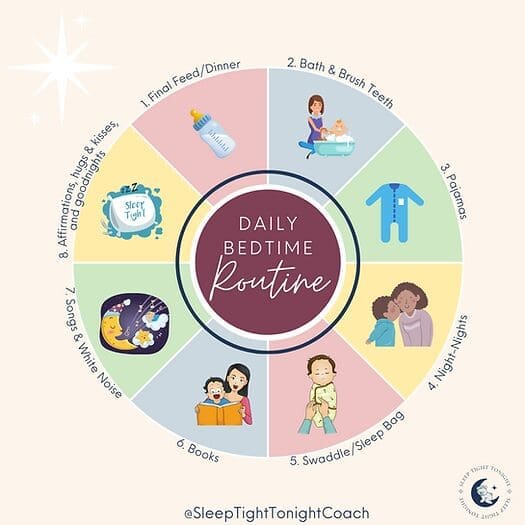
As baby grows, the routine may evolve
Initially, when starting a bedtime routine for your baby, it may involve using baby lotion, changing the diaper, cuddling, singing a lullaby, and reading a brief and soft bedtime story before putting the baby to sleep in the crib. As your baby grows, you can enhance the routine by including more frequent baths, saying goodnight to various objects in the house, reading a few books, singing a lullaby, and then concluding with positive affirmations and your chosen goodnight message.
With a little effort, you can create a bedtime routine that will help your baby sleep better and feel more rested. Think of it as an enjoyable time to bond with your baby rather than something everyone HAS to do because it is time. It’s important to note that individual babies may have different sleep patterns and preferences, so it’s essential to observe and adapt the bedtime routine to suit your child’s specific needs.
If your child (4 months–6 years old) is struggling with sleep and it no longer feels sustainable, you are not alone. It may be time for support. Schedule a free 15-minute consultation to discuss your challenges, your goals, and how Sleep Tight Tonight can help. ☎️

Caryn Shender, is a proud mom of two, a certified baby and child sleep consultant, founder of Sleep Tight Tonight, author of My Scar is Beautiful, safe sleep ambassador, mentor to other sleep consultants, and was awarded ‘Best of Georgia 2025’. She is passionate about and committed to helping families turn sleepless nights into peaceful nights and sweet dreams. Based in Atlanta, Georgia, she has helped hundreds of families across the US and around the world make sleep easy.
** Some links on this site may be affiliate links, which means we may earn a small commission if you make a purchase—at no additional cost to you. We only recommend products and services we genuinely trust and use. All opinions expressed are our own and are never influenced by affiliate partnerships.
Read the latest from Sleep Tight Tonight



0-3 months 4th of july baby sleep Best of Georgia contact nap fireworks holidays how to dress baby melatonin mental health naps newborn newborns newborn sleep rocking Safe Sleep sleep aids sleep associations sleep consultant sleep disruptions sleep products sleep regressions sleep struggles sleep training swaddle toddler sleep Tog top tips travel tips twins

